
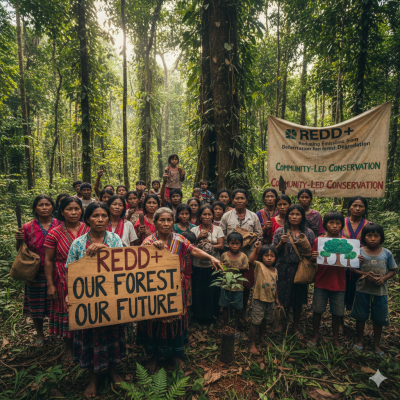
The Commoners’ Perspective of REDD+
Back in 2005, at the UN climate talks in Montreal, something awesome happened. Sir Michael Somare and Kevin Conrad stepped up to the mic and said, “Hey world, our rainforests are keeping the planet breathing. Can we please get some love (and funding) for protecting them? We can maintain a fresh breath on our planet.” There was an applause. And just like that, REDD was born.
Two years later in Bali (2007), the idea got its official stamp in the Bali Action Plan. REDD was now formal. Pretty soon people realized it should be about more than just discontinuing deforestation. It should celebrate conservation, smarter forest management, and even growing new trees. So they added a cheerful little “+” and REDD+ came to life.
By 2010 in Cancún, the world wrapped its arms around the concept. Everything got locked in safeguards, proper measuring, transparent reporting. Fast-forward to Warsaw 2013. The REDD+ rulebook was polished to perfection. Two years later, during Paris Agreement in 2015 REDD+ received its very own Article 5. REDD+ evolved from being a side project to a crucial part of fighting climate change globally. Article 6 carbon-trading rules were finally agreed in 2021 and switched on in 2024–2025. Now countries can proudly sell their verified REDD+ results on the global market. Huge win for the global warming and climate protection champions!
And here’s the really exciting part of REDD+. It isn’t a carbon market itself. Instead, it represents a smart, trusted UNFCCC framework that makes climate actions possible. Yet. It is not a subsidiary. It’s absolutely dominating in planet protection in the best way. Consider this- Between 2023 and 2025, forestry and land-use credits (mainly powered by REDD+) have made up a whopping 25–40 % of every voluntary carbon credit issued globally. Thus, REDD+ is a concept which originated from rainforest nations and evolved into one of the brightest, most effective tools employed by humanity to protect the planet. More importantly, it just keeps getting better.
Why REDD+ is Popular Today
REDD+ isn’t just another climate tool, it’s absolutely vital, and here’s why it’s a total game-changer.
First, it’s hands-down one of the biggest and cheapest sources of carbon credits out there, powering both the voluntary market and the fast-growing compliance markets. McKinsey’s cost curves from 2009 right through 2023 keep putting forest protection near the very top of the “biggest bang for your buck” list. Keeping tropical forests standing slashes emissions for as little as $5–20 per ton of CO?, sometimes even less in large jurisdictional programs. Compare this to $30–$100+ per ton for most renewables, industrial fixes, or coal-plant retirements. Without REDD+, today’s carbon markets would be tiny, clunky, and way more expensive. The cost-saving stands out as the main reason why companies, airlines, and governments chasing net-zero love REDD+.
The scale is mind-blowing too. Tropical deforestation still drives 10–15 % of all global emissions. Flip that around: protecting and restoring those forests can deliver gigatons of reductions or removals every single year—far more than wind, solar, or any other project type in the voluntary market can offer. Healthy tropical forests already pull 15–20 billion tons of CO? out of the air annually. Lose them, and we don’t just lose that sink; we release centuries of stored carbon in one go.
Most developed nations cleared their own forests long ago. The world’s remaining great rainforests are in developing countries. If we’re serious about staying under 1.5–2 °C, REDD+ isn’t optional. REDD+ supporters love pointing out its incredible win-win superpowers. Beyond cutting emissions, it actively safeguards biodiversity, fights poverty, and defends indigenous rights in rainforest nations. Keeping those forests standing literally stops iconic species. The famous jaguars, orangutans, gorillas and entire indigenous communities are saved from disappearing. No wonder REDD+ credits fly off the shelf with labels like “saved 200 majestic jaguars” or “supported 600 indigenous families.” That’s a powerful, heart-grabbing story. Try getting that same emotional punch from “funded another wind turbine in Texas” and watch the reaction.
Pretty much every big net-zero pledge, from corporations to cities to entire countries, quietly banks on massive amounts of avoidance and removal in the decades ahead. Guess which mechanism can deliver a huge chunk of that at scale? Definitely, REDD+ is brilliant because it does way more than just fight climate change. It directly helps achieve a whole bunch of the Sustainable Development Goals (SDGs). I’m genuinely excited to show you just how many of those global targets REDD+ supports!
SDG Goals that are Supported by REDD+
| Aspiration | SDG | Recommendation |
|---|---|---|
| A world of affordable and Clean Energy | 7 | This SDG calls for massive scaling-up of renewables and energy efficiency to promote Energy access + clean energy. |
| A world of low-carbon infrastructure and industrial processes | 9 | Industrialists should upgrade their systems to minimize their carbon emissions. |
| A world of sustainable cities and communities | 11 | We should implement low-carbon urban planning, including transport, and buildings for urban sustainability. |
| A world where consumption and production exhibit responsibility | 12 | We should reduce waste, and emphasize sustainable supply chains. This includes phasing out fossil-fuel subsidies(12.c). |
| Take urgent action to combat climate change and its impacts | 13 | Emissions to limit warming. Under SDG 13.a call is made on the implementation of $100 billion climate finance commitment. The bigger part of this funding is expected to be channeled to emission-reduction projects in developing countries. Part 13.b of the SDGs recommends promotion of mechanisms for raising capacity for climate planning, including national emission inventories and reduction strategies. Target 13.1 advocates for strengthening of climate resilience, indirectly targeting emissions. Target 13.2 calls for integration of climate change measures into national policies, strategies and planning. |
| Protect life on land | 15 | We should protect forests by halting deforestation (15.2) to sustain ~10–15% annual global emission reduction by these forests. |
From this, it is evident that REDD+ beautifully blends smart economics, fairness, and real climate impact. Honestly, we can’t afford to be without it.
Why Developing Countries Should Support REDD+
For rainforest developing nations, REDD+ isn’t charity. It us a unique smart economics that protects the forests their people and economies literally depend on. Almost twenty years ago, tropical countries faced a tough choice: clear priceless rainforests for soy, cattle, palm oil, mining or timber just to grow their economies, or somehow find another way. That’s when REDD+ stepped in with a game-changing idea make standing forests worth more alive than cut down. From inception, REDD+ put developing nations in the driver’s seat in planet protection. Governments actively participate in setting the rules, maintaining national control of climate initiatives, and deciding how biodiversity and climate protection money flows to indigenous communities and local people who protect the trees every day. A strong REDD+ track record even unlocks extra billions from the Green Climate Fund and other donors. Those payments flipped climate protection economics. Without doing anything, a hectare of intact rainforest could out-earn the same land cleared for ranching or plantations.
The combination proved irresistible, huge climate impact, jaw-dropping scale, rock-bottom costs, and stories that actually move people. REDD+ quickly evolved to become the biggest category in the voluntary carbon market and is now expanding into compliance markets. Done right, it delivers massive emissions cuts, safeguards rainfall for hydropower and crops for the developing nations (consider Brazil’s 2014–2015 drought that shaved 1–2 % off GDP), protects biodiversity, and channels real finance southward. Done poorly, though, REDD+ is a potential greenwashing nightmare.
Why Developed Nations Should Support REDD+
Developed nations caused 70–80 % of all CO? that’s ever built up in the atmosphere since the Industrial Revolution. Supporting REDD+ isn’t charity—it’s smart, affordable, and the right thing to do. REDD+ is the cheapest big-ticket climate action on the menu, it respects the “polluter-pay-principle” baked into the UNFCCC and Paris Agreement, and it’s politically easier than forcing painful cuts at home. Every hectare saved today spares people from spending fortunes later on high-tech carbon removal like DACCS or BECCS.
REDD+ bonuses are huge. It protects over half the world’s land species, keeps rain falling where farmers and cities need it, and backs indigenous communities who are the best forest guardians on the planet. Unchecked deforestation also fuels migration, conflict, and instability, supporting REDD+ calms those risks and builds stronger ties with key countries like Brazil, Indonesia, DRC, Peru, and Colombia.
REDD+ also allows money, rather than promises, to flow to the global south. Guyana pocketed $250 million from Norway for low deforestation. Brazil’s Amazon Fund has drawn over $1.3 billion from nations like Norway and Germany. Indonesia scored $110 million plus billion-dollar pipelines. Today, high-quality jurisdictional REDD+ credits fetch $15–30+ per ton in the voluntary market (up from $4 in 2018). Prospects tell a sweeter story. With Article 6 compliance markets opening, prices could hit $40–100 by 2030.
Bottom Line
REDD+ may not be perfect, but it looks like one of the few things that makes sky-high promises mathematically attainable. For developing countries, it stands out as one of the rare UNFCCC tools that actually sends serious money southward instead of just piling on more duties. For wealthy nations, it’s an elegant way to look like climate leaders and hit ambitious targets without the politically painful task of slashing emissions at home. For developed countries, REDD+ is the rare climate investment that’s cost-effective, morally sound, strategically wise, and delivers immediate global benefits.


Comments
Join a constructive discussion about the evidence, methods and implications.
No comments have been posted yet.